"Back when the working document for the Synod was released, Father Gerald Murray, writing for The Catholic Thing on June 24, 2023, predicted the outcome:
a make-believe, delusional religion of self-worship in which God is relegated to the role of the Divine Affirmer of whatever each one decides to believe.
The question for us pew-sitters is, do we wish to remain in a “make-believe, delusional religion?” It’s a trick question. The church that Father Murray envisions is not the Catholic Church. It is an institution that looks for all the world like the Catholic Church, but is not. It is the “ape of the Church” that then-monsignor Fulton J. Sheen foresaw in 1947.
Archbishop Viganò expressed a similar view at the Catholic Identity Conference in Pittsburgh in October, 2020. He said, “we have witnessed the eclipse of the true Church by an anti-church,” a church which he called “an infernal forgery.” He went so far as to observe that we may be seeing the prophecy of Fulton Sheen coming true before our very eyes.
Archbishop Viganò made it clear that there are not two Catholic Churches. “Obviously, there are not two Churches, something that would be impossible, blasphemous and heretical.” To continue his eclipse metaphor, the one true Catholic Church is still there, but we cannot see it. It is blocked from our view by something else.
In addition, for those critics of Trads out there who foolishly think rhetoric like this is “schismatic,” please listen to one of the heroes of Vatican II, who said something similar way back in 1967:
It is clear that the Church is facing a grave crisis. Under the name of “the new Church,” “the post-Conciliar Church,” a different Church from that of Jesus Christ is now trying to establish itself: an anthropocentric society threatened with immanentist apostasy which is allowing itself to be swept along in a movement of general abdication under the pretext of renewal, ecumenism or adaptation.[1]
So where is the real Catholic Church, the one that is eclipsed? The one that is being aped? The one that we will never leave? At some point, no doubt, it will again become visible. In the meantime, however, we must take charge of our own salvation and discern the true Church as best we can.
Guideposts
Religion is a matter of faith and morals. The doctrines and dogmas of the Faith do not change. The precepts of morality do not evolve. They are taught, preserved and handed down from one generation to the next. Who would assent today to the tenets of a religion that could change tomorrow? Find sources that contain what the true Church has always taught about the things that matter for your own salvation, namely, death, judgment, heaven and hell.
Religion is also a matter of worship. In Catholicism, worship most commonly takes place at the Holy Sacrifice of the Mass. Sacrifice is the most ancient and most fundamental element of worship. During the Mass, a validly-ordained priest brings Jesus Christ Himself to the altar and offers Him as a sacrifice to Almighty God. That’s it; that’s the core of Catholic worship. Everything else is ancillary: the homily, the readings, even Communion. The true Catholic Church is found where worship centers around the Mass as a sacrifice.
Some Tools
With so much at stake, we want to be confident in our tools. Here are some tools that I have found helpful in discerning the genuine Catholic Church.
The Baltimore Catechism. How often do we hear about Catholics who are “poorly catechized,” meaning Catholics who do not know the basics of their Faith? I suspect that they have never been exposed to the Baltimore Catechism. In the 1950s, this was our religion textbook. Because of its question-and-answer format, it is easily dismissed as “Catholicism for children.” In fact, it is theology in easy-to-consume morsels.
The Douay-Rheims Bible. There is no “best” version or translation of the Bible. Unless you can read Greek and Hebrew, however, you are going to have to rely on someone’s translation of the Bible in order to read it. Legitimate principles of translation will give a particular tone to any given version. However, some versions have been created with an agenda to slant the translation for a particular purpose.The Douay-Rheims Bible is a translation of the Latin Vulgate, which itself is a translation from the original Hebrew, Aramaic and Greek. It, too, has a backstory, but it predates modern influences.
The Rosary. This is perhaps the most basic tool in the tool kit. The prayers of the rosary begin with The Apostles’ Creed. (You can find that in the Baltimore Catechism.) Say the Creed slowly and absorb the articles of your Faith. Each decade of the rosary begins with the Our Father and is comprised of 10 Hail Marys. These are the most basic prayers in Catholicism. (You can find them in the Baltimore Catechism as well.) When you meditate on the “mysteries” of the Rosary, you re-live the foundational events of Christianity. For best results, recite daily.
Catholic Bible Dictionary by Dr. Scott Hahn. When I have questions about some aspect of the Faith, this is the first place I go. Dr. Hahn did the research so we don’t have to. He is one of the most famous converts to Catholicism. If you have a question, it is likely that he had it first and found the answer.
Fulton Sheen videos. Bishop Sheen had a popular weekly network telecast in the 1950s. He continued on television for several years thereafter. Most episodes are available on YouTube. His message resonated with audiences then and it rings true today. Rediscover America’s bishop and learn his lessons for life.
Christus Vincit: Christ’s Triumph over the Darkness of the Age, by Bishop Athanasius Schneider. The book could have been subtitled, “Clarity and hope in the days of tribulation.” If the Baltimore Catechism is too simplistic for your tastes, there is an appendix containing a “Declaration of Truths” about the Catholic Faith that may be more to your liking. Read this book and be reaffirmed that your search for the real Catholic Church is not in vain."
Alice in Wonderland by Lewis Carroll is a beloved classic that provides valuable life lessons through its whimsical and fantastical narrative. This essay aims to explore the profound teachings hidden within the narrative, shedding light on the transformative journey of Alice and the essential wisdom she gains. The formal tone will be maintained throughout the discussion, ensuring a respectful and academic undertone.
One of the primary lessons that Alice in Wonderland teaches is the importance of embracing change and adaptability. Throughout her strange and unpredictable journey, Alice encounters numerous peculiar characters and situations that challenge her understanding of reality. Her size fluctuates, she finds herself in unusual predicaments, and she often faces the absurdity of Wonderland's inhabitants. However, instead of resisting these changes, Alice learns to adapt and navigate through them. By remaining open-minded and flexible, she discovers her ability to overcome unexpected obstacles and thrive in unfamiliar circumstances.
Moreover, Alice in Wonderland emphasizes the necessity of self-acceptance and self-belief. Alice's sense of self is repeatedly questioned as she faces bizarre creatures that constantly challenge her identity. The Caterpillar, for instance, asks her, "Who are you?" This question forces Alice to reflect on her own existence and the need to establish a firm sense of self. As the story progresses, Alice learns to trust her instincts and grow comfortable in her own skin. She realizes that only by accepting herself for who she truly is can she find her way back home.
Another significant lesson conveyed in Alice in Wonderland is the power of questioning and challenging social norms. Wonderland is a world where logic is turned upside down, and authority is often undermined. Alice's curiosity allows her to question the irrationality and absurdity of the Wonderland characters' behavior. By challenging the status quo, she ultimately reveals the flaws in the system and exposes the unjust hierarchies that exist. This serves as a reminder of the importance of critical thinking and the need to question societal conventions that may hinder progress.
Furthermore, Alice in Wonderland imparts the essential lesson of perseverance and resilience. Alice faces numerous setbacks and frustrations throughout her journey. From shrinking too small to enter a door to the Queen of Hearts' constant threats, it seems that every step is a struggle. Nevertheless, Alice remains determined and refuses to give up. Her persistence inspires readers to keep going despite obstacles and discouragement, reminding them that success often requires enduring through hardships.
In conclusion, Alice in Wonderland is not merely a whimsical tale but a treasure trove of valuable lessons. From embracing change and adaptability to self-acceptance and challenging societal norms, the narrative provides insights that are applicable even in our own non-wonderland world. By maintaining a formal tone throughout this essay, the intention is to approach the subject matter with respect and academic rigor, acknowledging the significance of Carroll's work as a literary masterpiece. Thus, readers can gain a deeper understanding of the transformative journey of Alice and the wisdom she learns along the way.
Victor Hugo's masterpiece, "Les Misérables," delves into profound themes of redemption, justice, and morality, portraying the complex characters of Javert and Jean Valjean. In this article, we will explore the striking comparisons and contrasts between Javert's character and the principles of Judaism, as well as Jean Valjean's character and the essence of Catholicism.
Javert and Judaism: Unyielding Law and Justice
Javert, the relentless inspector in "Les Misérables," embodies the unwavering pursuit of justice, rooted in strict adherence to the law. His character mirrors many aspects of Judaism, a faith deeply founded on the Mosaic Law and its ethical principles. Just as Javert views the law as an absolute moral guide, Judaism centers on the Torah as the ultimate source of guidance for personal and communal conduct.
Similar to Judaism's emphasis on justice and righteousness, Javert's worldview revolves around the idea that society can only function smoothly when everyone adheres to the law without exceptions. In his pursuit of Jean Valjean, he reflects the pursuit of justice in the face of personal vendettas and the quest for truth above all else, drawing a parallel with the Jewish concept of Tzedakah (righteousness and charity) as essential values in fostering a just society.
However, the rigid nature of Javert's adherence to the law also reveals a limitation, as he lacks the capacity to see the shades of gray in human existence. Judaism, while valuing the law, also recognizes the significance of mercy and compassion in balancing justice with forgiveness.
Jean Valjean and Catholicism: Redemption and Compassion
Jean Valjean, the central character of "Les Misérables," is a profound embodiment of redemption, resilience, and compassion, reminiscent of the core principles of Catholicism. Valjean's transformation from a bitter ex-convict to a benevolent and selfless individual is reminiscent of the Catholic concept of repentance and the transformative power of divine grace.
Catholicism emphasizes the notion of compassion and forgiveness, mirroring Jean Valjean's act of mercy towards others. His selfless acts, such as adopting Cosette and saving Marius, showcase the essence of the Christian virtue of agape love – an unconditional love and concern for others.
Furthermore, the portrayal of Valjean's internal struggle and his decision to turn away from his criminal past align with the Catholic idea of free will and the continuous battle between good and evil. Catholicism, like Valjean's journey, encourages individuals to seek redemption and atonement for their sins through genuine contrition and moral change.
Contrasting Perspectives: Legalism vs. Grace
The striking contrast between Javert and Jean Valjean reflects the juxtaposition of legalism and grace in both Judaism and Catholicism. Javert's unwavering pursuit of justice exemplifies the importance of adhering to moral codes and societal laws, but it also demonstrates the potential pitfalls of rigid legalism, devoid of compassion and understanding.
On the other hand, Jean Valjean's transformation exemplifies the central theme of grace in Catholicism – the idea that divine love and mercy can lead to profound transformation and redemption. His journey showcases the belief that every individual, regardless of their past, possesses the potential for spiritual renewal and salvation.
Conclusion
"Les Misérables" beautifully weaves together the intricacies of human morality, redemption, and justice through the compelling characters of Javert and Jean Valjean. The parallels between Javert and Judaism highlight the importance of upholding the law and seeking justice, while the resemblances between Jean Valjean and Catholicism emphasize the transformative power of redemption and the significance of compassion and forgiveness.
Through these contrasting characters and their respective religious connections, Victor Hugo's masterpiece reminds us of the complex interplay between the pursuit of justice and the capacity for mercy and grace in the human experience.
Attraction and mate selection have long fascinated researchers, prompting investigations into the factors that shape our preferences. Recent studies have shed light on the dynamic nature of attraction, highlighting the impact of contextual factors and women's reproductive cycles on their perceptions of masculinity. Moreover, emerging evidence suggests that elements of a woman's sex drive may involve intricate brain mechanisms beyond her conscious control. Let's explore these intriguing findings further.
Contextual Influence on Perceptions:
Research indicates that the value women place on masculinity can vary depending on the context in which it is assessed. Studies have found that ovulating women tend to perceive facial masculinity, characterized by square jaws and well-defined brow ridges, as desirable traits for potential mates. This preference aligns with evolutionary theories suggesting that during ovulation, women may seek partners with traits associated with good reproductive potential.
Conversely, when women are not ovulating, such as when using hormonal contraceptives like the pill, their preferences may shift towards feminine traits in potential partners. This phenomenon could be attributed to the altered hormonal environment created by contraceptive use, leading women to prioritize other qualities besides reproductive fitness in their choice of mates.
The Complexities of Women's Sex Drive:
Understanding the intricate workings of human desire is an ongoing scientific endeavor. While attraction and sexual behavior involve both conscious and unconscious processes, recent studies suggest that some aspects of a woman's sex drive may involve neural mechanisms beyond her direct control. These "tricks" in the brain are part of a complex interplay of hormones, neurotransmitters, and cognitive processes that influence sexual desire and response.
It's important to emphasize that these neurobiological processes do not diminish a woman's agency or autonomy in her romantic and sexual choices. Rather, they highlight the multifaceted nature of human sexuality and provide insights into the underlying mechanisms that shape our preferences.
Implications and Future Directions:
The evolving understanding of attraction and the influence of context and biology on women's preferences have broad implications for various fields, including psychology, evolutionary biology, and reproductive health. Further research is needed to explore the intricacies of these phenomena, considering diverse populations and cultural contexts.
This emerging knowledge can also inform discussions surrounding gender roles and stereotypes, encouraging a nuanced understanding of attraction dynamics that goes beyond simplistic generalizations. Recognizing the fluidity of preferences and the individuality of human experiences can foster greater acceptance and respect for diverse expressions of attraction and desire.
Conclusion:
Studies suggesting that the value women place on masculinity changes with context and their reproductive cycles, along with insights into the complexities of women's sex drive, offer valuable contributions to our understanding of human attraction. By exploring these intricate dynamics, we can continue to deepen our knowledge of human behavior and pave the way for a more inclusive and nuanced perspective on love, relationships, and sexuality.
"Alice's Adventures in Wonderland" by Lewis Carroll is a classic children's book that has entertained and inspired readers for over a century. The story follows Alice as she falls down a rabbit hole and enters a strange and whimsical world filled with peculiar creatures and nonsensical events.
Here are some of the lessons that can be derived from Alice's adventures in Wonderland:
Embrace your curiosity: Alice's curiosity leads her on an incredible adventure that she never could have imagined. The story teaches us to embrace our own curiosity and explore the world around us with an open mind.
Be true to yourself: Throughout the story, Alice struggles to understand her own identity and place in the world. She learns that it's important to be true to yourself, even when others try to tell you who you should be.
Embrace change: Alice's adventures in Wonderland are constantly changing and evolving. The story reminds us that change can be exciting and that we should embrace new experiences and opportunities.
Words have power: Alice's encounters with the Queen of Hearts and the other characters in Wonderland show us that words have power and that we should use them carefully. The story encourages us to think before we speak and to be mindful of how our words affect others.
Follow your own path: Alice's journey through Wonderland is unique and unpredictable. The story teaches us to follow our own path in life, even if it leads us down unexpected roads.
Embrace the absurd: Wonderland is a world filled with absurdity and nonsense, and Alice learns to embrace the strange and unusual. The story encourages us to find joy in the unexpected and to embrace the absurdities of life.
Overall, "Alice's Adventures in Wonderland" is a timeless story that teaches us to embrace our curiosity, be true to ourselves, and find joy in the unexpected.
Let Alice guide you through some of life's most important lessons
Lewis Carroll’s Alice has been enchanting audiences worldwide for over 150 years. Since first darting down the rabbit hole in 1865’s Alice’s Adventures in Wonderland, the eponymous adventurer has appeared in more than 40 cinematic adaptations, with the last as recent as 2016.
It’s no wonder that Alice continues to inspire, with all versions of her story brimming with applicable, everyday wisdom and advice way before Instagram cornered the affirmation market. By tripping through all the twisty linguistics, amazing animation and iterations of Alice, we can learn important lessons to bring back from Wonderland. Here are our favourites.
Risk has rewards
Sure, crawling down a rabbit hole might be too big a risk in the real world, but Alice’s decision to follow the White Rabbit leads to a magical journey. It’s not all smooth sailing, as she encounters obstacles, gets lost and the Queen of Hearts is obsessed with taking her head, but by the time Alice wakes from Wonderland she’s armed with new experiences to help navigate real life.
Though taking risks can be scary (like crawling down a rabbit hole), but standing still can be scarier. Without taking risks and challenging ourselves, we don’t grow.
We really shouldn’t be doing this, after all, we haven’t been invited, and curiosity often leads to trouble.
Discover who you are
When the Caterpillar asks Alice, "Who are you?", she can’t find a simple answer. Not just because she’s shifted sizes so much since falling down the rabbit hole, but because Alice is unsure just who she is.
While Alice’s adventure might seem mad on the surface, its main goal is answering the Caterpillar’s question and figuring out the greatest puzzle of all – "who in the world am I?". Life can also seem mad but by discovering who we are, and accepting ourselves, assures a much smoother ride through our own journey.
Also included in this idea is Alice’s own lesson on advice, "She generally gave herself very good advice, though she very seldom followed it". By learning to listen to our instincts and be a little more objective, we can apply the wisdom we give to others to ourselves.
Accept the differences of others
"But I don’t want to go among mad people," Alice remarked. "Oh, you can’t help that," said the Cat: "we’re all mad here. I’m mad. You’re mad."
Learning to accept who we are is one of life’s great lessons, but so is learning to accept the differences in others. Even if we’re certain of who we are, the people around us aren’t always going to be who we want them to be – and that’s fine. Celebrating people’s differences makes life more interesting, exposes us to new perspectives and opens new worlds, just like Wonderland.
Don’t get stuck in the past
"It’s no use going back to yesterday, I was a different person then," Alice tells the Mock Turtle and Gryphon.
While this shows just how much has happened to Alice since her journey began, Lewis Carroll imbues the line with multiple meanings. Alice’s adventures are about personal evolution, and this lesson affirms that by reminding ourselves that we’ve grown since yesterday, a week ago, a year ago or decades ago. By closing past chapters, we can write our future without stewing on the regrets, mistakes and disappointments we all encounter.
Stand up for yourself
"Hold your tongue!" said the Queen, turning purple.
"I won’t!" said Alice.
Accepting other people is good, but sometimes people are just jerks. The Queen of Hearts, for example, gets her excitement from belittling, berating and beating her subjects, including her own husband. When precocious Alice enters her kingdom, the Queen gets guillotines and rolling heads in her eyes, just like bullies the world over. But one of the most important lessons for any young person to learn is not to let bullies get you down and always stand up for yourself.
By realising that the Queen of Hearts minions are just a pack of cards, Alice changes her perspective to see that the aggressive people in her life cannot hurt her if she changes her view.
Breaking News from Una Voce Malta: Modernist Vatican will only allow the traditional Mass to be said within the context of the New Church if it accepts the Lectionary and Calendar of the Novus Ordo. This would mean that the traditional Catholic Mass would not be allowed within the context of New Church. Notice the section of the story about the Fraternity of St. Peter and the Institute of Christ the King. Also, the SSPX will only be given a "temporary exemption" "in order to make the reconciliation possible." No other exemptions will be allowed! Note the smug establishment description of Una Voce of itself. Basically, the True Mass with Catholic worship and prayers and celebrations will only be possible in, what Fr. Malachi Martin called 20 years ago, the "Underground Church."
Reliable sources close to the Holy See have indicated that sometime in the second half of 2018, the Novus Ordo Lectionary and Calendar are to be imposed upon the Extraordinary Form of the Roman Mass.
The new Roman Missal will become available on the First Sunday of Advent 2018 but the Vatican will allow a two-year period to phase it in. These changes are expected to be much more drastic than what was envisaged in Universae Ecclesiae that states:
25. New saints and certain of the new prefaces can and ought to be inserted into the 1962 Missal, according to provisions which will be indicated subsequently. (emphasis ours)
The Vatican approved societies and institutes, such as the Fraternity of Saint Peter and the Institute of Christ the King, will likely apply for exemptions, but all requests are expected to be turned down. The only exception seems to be the SSPX, which might be granted a temporary exemption, to ensure that an agreement is reached between the SSPX and Rome. However, if the exemption granted will be of a temporary nature, more SSPX priests are expected to join the so-called Resistance (formerly known as SSPX-SO) under Bishop Richard Williamson and more will go independent.This would make the traditional Catholic movement more fragmented than ever before.
I, the undersigned, being of sound and disposing mind and memory, do hereby in the presence of witnesses make this Declaration of Life.
BACKGROUND
1. I believe that the killing of one human being by another is morally wrong.
2. I am opposed to capital punishment on any grounds whatsoever.
3. I believe it is morally wrong for any state or other governmental entity to take the life of a human being by way of capital punishment for any reason.
4. I believe that capital punishment is not a deterrent to crime and serves only the purpose of revenge.
THEREFORE, I hereby declare that should I die as a result of a violent crime,
I request that the person or persons found guilty of homicide for my killing not be subject to or put in jeopardy of the death penalty under any circumstances, no matter how heinous their crime or how much I may have suffered.
I believe it is morally wrong for my death to be the reason for the killing of another human being.
I request that the Prosecutor or District Attorney having the jurisdiction of the person or persons alleged to have committed my homicide not file or prosecute an action for capital punishment as a result of my homicide.
I request that this Declaration be made admissible in any trial of any person charged with my homicide and read and delivered to the jury.
I request the Court to allow this Declaration to be admissible as a statement of the victim at the sentencing of the person or persons charged and convicted of my homicide; and to pass sentence in accordance with my wishes.
I request that the Governor or other executive officer(s) grant pardon, clemency or take whatever action is necessary to stay and prohibit the carrying out of the execution of any person or persons found guilty of my homicide.
This Declaration is not meant to be, and should not be taken as, a statement that the person or persons who have committed my homicide should go unpunished.
I request that my family and friends take whatever actions are necessary to carry out the intent and purpose of this Declaration; and I further request them to take no action contrary to this Declaration.
During my life, I want to feel confident that under no circumstances whatsoever will my death result in the capital punishment of another human being.
I request that, should I die under the circumstances as set forth in this Declaration and the death penalty is requested, my family, friends and personal representative deliver copies of this Declaration as follows: to the Prosecutor or District Attorney having jurisdiction over the person or persons charged with my homicide; to the attorney representing the person or persons charged with my homicide; to the judge presiding over the case involving my homicide; for recording, to the Recorder of the County in which my homicide took place and to the Recorder of the County in which the person or persons charged with my homicide are to be tried; to all newspapers, radio and television stations of general circulation in the County in which my homicide took place and the County in which the person or persons charged with my homicide are to be tried; and to any other person, persons or entities my family, friends or personal representative deem appropriate in order to carry out my wishes as set forth herein.
I affirm under the pains and penalties of perjury that the above Declaration of Life is true.
Can you explain (or point to a website that explains) how band members got onto the (Tomorrowland Terrace) stage before it came up? I googled this but could not find anything concrete about a tunnel to backstage. This seems likely to me and there should be a map somewhere that shows the “other” exit from the tunnel. It would be great to see the exit from google maps, satellite view.” Well I had never thought of this question before. I know there was a way down but never gave it much thought. So I decided to enlist some Disneyland experts in the Micechat.com Forum! I got many great responses so let me summarize them for David. Yes, there is a tunnel! It starts near the old Alpine Gardens (near the Yeti footprint) and ends behind Innoventions. That’s how bands get from backstage to the TLT onstage area, and how the Jedi Training Academy CM’s and characters get to Pixie Hollow. There are also dressing rooms and showers down there. Word is when the trash compactor overflows it ends up in the tunnel that then has to be mopped out! The access tunnel is also how the Coke syrup used to be pumped to Coke Terrace when Coke sponsored it. A big stainless steel tanker truck, not unlike the trucks hauling milk, would squeeze into the access area behind innovations and hook up hoses and deliver the syrup through pipes mounted to the ceiling of the tunnel.
Per David’s request I have made a map of the tunnel based on eye witness reports. If anyone has corrections to this map or photos of this area please let me know.
The tunnels have the same vibe and feel of their bigger cousins at WDW. The WDW tunnels under Main Street look very similar but are much larger both in height and width. Even the layout is similar electrical rack on the bottom right, water supply (most likely cold water for a/c) on the right mid level and top right HVAC and tubes for the trash.
The backstage entrance behind what was then America Sings was next to the cargo elevator that was used to get large pieces of equipment into the tunnel such as electric carts, trash compactor receptacles for the trash compactor under the Tomorrowland Terrace, supplies, etc. From the tunnel, there was a way to get up into the underbelly of the carousel theater. There was quite a bit of space under the Tomorrowland Terrace, as described in more detail by your source. The pictured doors in this latest post, are not the termination point of the tunnel at the old Circlevision building. During the years I worked there, the door to the right was an emergency exit out of administration offices, the double-doors in the center were an emergency exit out of the Circlevision Theater, and the door to the left was a stairwell up to the CircleVision Projection room. Instead, the western termination point was at the north west corner of that building on the west side behind a single unmarked door.
“I worked in the Tunnel for 9 Years, it had two bends in it. The opposite end from the Freight Elevator had a stairway that led upstairs to an outside door to a walkway that surrounded the Matterhorn, their was also a large room at that end with a bunch of pipes, probably for water circulation for the Matterhorn. The tunnel also provided a way to deliver goods for the Tomorrowland Terrace facility, we also used to store about 10 ea pallets of supplies in the tunnel until we got the refreigerated goods away and could store the paper goods. I used to clean out the coke tanks and change them over via a valve when one would run out. The tanks were in a locked room just behind inovations. They were about 2000 gallons in size ea and all stainless steel. A stainless steel pipe ran the length of the Tunnel to Tomorrowland terrace to supply the syrup for our most popular drink “Coke”.
Unrelated tunnels for the Rocket Rods which connect Little Green Men store
There are some occasions in which it is clearly permissible, for example when a person has a pair of organs, only one of which is really necessary. One can be removed to transplant to another person, such as a kidney transplant. There are other cases in which it is permissible, for example when the organ can be taken when the person is clearly already deceased, such as eye corneal transplants.
However, it is manifestly immoral to kill a person to take one of their organs, although that person would have died on his own within a short period of time. It is never permissible to kill one person just to help another. Only God has power over life and death.
The problem arises because once a person has really died and his cardiac and respiratory functions have ceased for several minutes, then his organs will be damaged in such a way that they cannot be used for organ transplants. Hence the organs must be removed first.
The big dispute presently concerns when a person is alive or dead. This involves the concept of brain death. The medical profession generally considers that when a person has been proven to be brain dead, for example by a flat EEG or by the absence of respiration when the respirator has been turned off, then he must be considered to be dead, despite the fact that his cardiac and respiratory functions are being artificially maintained. Consequently, it is permitted, so they say, to remove any or all organs from a person who is still breathing and whose heart is still beating, so long as they are proven to be brain dead. This has actually become big business, and a "living corpse" like this is worth probably more than $80,000 for its internal organs.
This practice is not only disgustingly inhuman. It is manifestly anti-God and immoral. Death is the moment at which the soul leaves the body. This is known only to God, the creator of life. While a person is still breathing, even artificially, and while his heart is still beating, he has many signs of life. His body is being maintained in life by the circulation of blood. He is still a human being. It is true that if his brain is dead he will never think again, and he will not have the reflexes and reactions that depend upon brain function. However, this does not mean that he is not alive. It just means that there is a permanent irreparable impairment to his human activities. It is not for man to decide that he is not a man and that he is not alive. Consequently, he must be treated as a living person. Hence no essential organs can be removed until well after all respiration and cardiac action have ceased.
"Cadaveric" transplantation is a misnomer, and is used to describe the removal organs from a person who has been declared brain dead, but who is being kept alive by artificial means.
Note that the pope’s address is not a statement of the Church’s Magisterium , and that it makes no definitions or clear statements on Faith or morality. I will pass over the humanistic and naturalistic tone of this discourse, which speaks of the dignity of the human person, but not of the salvation of souls. I would, however, like to bring up the crucial statement in this document, which the pope uses to justify his personal opinion that it is licit to harvest organs from brain dead people, who are being alive by artificial means, in order to treat medical conditions by transplantation. This statement is this: "the criterion adopted in more recent times for ascertaining the fact of death, namely the complete and irreversible cessation of all brain activity, if rigorously applied, does not seem to conflict with the essential elements of a sounds anthropology." (§5)
The pope’s very hesitant statement is quite simply wrong. The Church teaches that reason can prove with certitude the spirituality and the immortality of the human soul (Ds 2766 and 2812). This means that the soul is not bound to any organ of the body, including the brain. The soul is not dead or absent just because the brain is incapable of functioning, short of a miracle. Death is in fact the separation of the soul from the body. As the pope himself correctly points out, the precise moment of death "is an event which no scientific technique or empirical method can identify directly" (§4). It is for this reason that a priest can conditionally administer the sacrament of Extreme Unction for up to an hour after a person has been medically declared dead.
The pope’s argument is that we can accept the neurological criteria of death have replaced the cardio-respiratory criteria, namely the cessation of heart and lung activity for a period of time beyond which it is no longer possible to revive them. It is true that the neurological criteria give the moral certitude that the person will die when the cardio-respiratory life support systems are removed. However, they give absolutely no certitude that the person is already dead, in the true sense of separation of soul and body. Moral certitude of this is only possible when corruption takes place, as sure proof that human life is no longer present in the corpse. However, as long as respiration and cardiac function are maintained, albeit artificially, the tissues and cells of the body will certainly stay alive and nourished, and the body remains one organism, with one being, that is to say one soul. Corruption is the only sure sign that the unity of the being is lost, and that consequently the immortal soul is separated from the body. Once corruption sets in and death is certain, it is certainly permissible to use organs for experimental and other uses, provided that there is a proportionally grave reason. However, since corruption involves a disintegration of the tissues and organs, they cannot then be used for transplantation purposes.
How can it be said that with certitude, that the human soul is no longer present in an apparently live body whose brain is dead? And if the human soul is in all probability present, how can the removal of organs necessary for life be justified? The moral certitude that the brain dead person will die in any case is irrelevant. He is presently, to all appearances and in all likelihood still alive, and the removal of organs necessary for life could be the direct cause of his death? Surely to be responsible for this is a sin against the fifth commandment. Surely man cannot claim this right to kill another person simply because of the benefit that could accrue to a third person. This is utilitarianism, considering man as a means to an end.
Consequently, the medical diagnosis of brain death can not be considered as giving the medical profession the right to declare a person as dead quite simply. Furthermore, it is not permissible to accept organs necessary for life, such as the heart, lung, or liver, removed from a person in such a state. It is consequently my opinion that the present day practice of "cadaveric" transplantation is immoral and illicit, and it is not permitted for a Catholic to authorize his or another’s donation or even to accept organs harvested in this way.
In fact, the definition of "brain death" may have come into use in place of the traditional signs of death partly because of the desire to "harvest" organs for transplants into others. Many physicians themselves will admit that they know of cases were a person has been dubiously declared "brain dead" because an organ recipient is waiting. By the time traditional death is clear, the organs are no longer "harvestable." Thus, some say that organ donation may have been a foot in the door to a secularized, rather than a Catholic, morality.
You may find these and other differences between the Traditional Latin ('Tridentine') Mass and the New (Novus Ordo) Mass of the 1960's (most commonly said at Catholic parishes at the end of the 20th century):
The 'Tridentine' Mass has a more vertical focus - a focus more on God than on fellow parishioners
The 'Tridentine' Mass is clearly a sacrifice (as opposed to a meal, as many 'moderns' want the faithful to view the Mass)
The 'Tridentine' Mass emphasizes self-denial, awareness of sin
In the 'Tridentine' Mass, the priest typically faces eastward, symbolically towards Christ (not towards the parishioners)
In the 'Tridentine' Mass, there is increased reverence at the altar and extreme reverence for the Holy Eucharist
In the 'Tridentine' Mass, there are ample references to atoning for sin, hell, judgment, and the intercession of saints
In the 'Tridentine' Mass, a fixed liturgy - containing the traditional prayers - is used throughout the Church, which is not subject to personal preference or manipulation
In the 'Tridentine' Mass, there are reverent silent periods where the priest leads prayers on our behalf
In the 'Tridentine' Mass, there is more genuflecting and kneeling
The 'Tridentine' Mass uses a different, fuller calendar
In the 'Tridentine' Mass, there are fewer rote responses by the parishioners
In the 'Tridentine' Mass, the unchanged, traditional prayers of consecration are used
In the 'Tridentine' Mass, Holy Communion is given only by priests - to kneeling communicants on the tongue (excepting, of course, those physically unable to kneel)
In the 'Tridentine' Mass, there are no 'altar girls', no lay readers, and no 'Eucharistic ministers'
In the 'Tridentine' Mass, there is a longer silent period after Communion for prayer & thanksgiving
In the 'Tridentine' Mass, pipe organs and Gregorian chant are employed rather than guitars and drums
In the 'Tridentine' Mass, the priest is not sitting off to the side while laity 'take charge'
In the 'Tridentine' Mass, there is no hand-holding or "kiss of peace" among the laity
In the 'Tridentine' Mass, the stable rubrics help assure that liturgical abuses do not occur
And, of course, the Latin language is used for the the 'Tridentine' Mass universally. The same all over the world (you may follow along with a Latin/English(or vernacular) missal)
"Ah, the kiss, the connection of two souls, the action that binds both young and old lovers for eternity. The romantic tension ... the passion ... the intimacy ... the lust ... the burning desire ... the hunger for more ..."
Science Says:
There's a cluster of chromosomes present in the body called MHC (major histocompatibility complex) that controls part of your immune system. And when you're out looking for someone to breed with, MHC is probably the most influential aspect of a partner that you didn't know you were judging. MHC controls your ability to fight off infection, and if you breed with someone whose MHC is similar to your own, the pregnancy is less likely to take. Finding someone whose MHC is different means a more diverse immune system for the child.
In other words, evolution supports getting strange with strangers.
In fact, according to a report in Psychology Today, the scent of MHC might be the second-most-important factor in determining how attractive a woman finds a potential mate. While you might not realize you're secretly judging someone you just met on how well your child would be able to fight off a cold, that's what's happening. Your body tries to instinctively make sure that each potential partner has the sexual compatibility seal of approval. Now how does it do that?
MHC is present in both pheromones and saliva, meaning that to really detect whether a partner is suitable, one must be in close proximity (to smell the MHC), and there must be an exchange in saliva (to taste the MHC). Now, what usually happens when these two events are placed together? That's right, ladies and gentlemen -- the kiss is in fact a taste test. We've adapted the behavior to make sure we find someone with whom our chemicals match up.
"Wow! We both taste like shame."
So all that stuff about loving someone's soul? You could go out and find someone who shares your interests, reads the same manga, orders the same pizza, gets along with your parents and even gets the "subtle intelligent humor" that you (and only you) understand. All it would take is the taste of that person's saliva for that interest to go from "I want to make love to you right now! I don't care if the kids I'm babysitting are watching" to "I like you, but more like a brother."
If she's been on birth-control pills the whole time you dated, there's a chance you're both being tricked into marrying exactly the wrong person by your own bodies.
When a woman is actually pregnant, her body decides, "It's not like I can get more pregnant," and it stops doing a bunch of the things it normally does. The pill basically uses hormones to convince a woman's body that it's already pregnant. The woman doesn't want to get pregnant, her body thinks it's pregnant, everyone's happy.
Or at least, they would be if it weren't for that pesky MHC stuff controlling who you can fall in love with. Just as a pregnant woman might find herself suddenly craving food she used to find repulsive, her taste in MHC undergoes a polar reversal. She's no longer attracted to people with MHC that is dissimilar to hers, and way more attracted to men with similar MHC. From an evolutionary perspective, this was probably so that women would want to spend more time around family members in a protective environment rather than out at a bar trying to get laid again. In a modern context, it's probably why pregnant women so often want to murder their husbands with a meat cleaver: He no longer smells like her type, and it's far too late for that.
A woman on the pill gets exactly the same effect, without the belly or the appearance of the boob fairy. For the entire time she's on the pill, a woman will prefer people with MHC that is similar to her own. This is why some psychologists believe that the high divorce rate in modern times can be blamed on the pill. Two people can be dating for years, thinking they're meant for each other when in reality, their MHC is the exact opposite of compatible. Of course, they only find out when they're ready to hatch one and she goes off the pill, which of course is often way, way too late.
1) To adore, love and serve God in the most dignified way possible in this life on earth. The primary reason we were created was to adore, love and serve God, in this life and in the life to come in heaven. This is what gives meaning to this life and our eternal life.
2) To defend and preserve the Catholic faith in its Ancient Liturgy and Teachings. Lex Orandi (How we pray.) protects Lex credendi (What we believe), that leads to Lex Vivendi (How we live our lives). And this is why we are giving our lives to defend and preserve what was passed on to us from before our time.
3) To obtain a personal union with God through the practice of this ancient Catholic faith. In living a orthodox life and praying in a manner that pleases God, graces are given to us to obtain our final goal, a loving union with God in this life and in the one to come.
4) To grow in holiness in our ordinary daily lives. No matter what we may believe and know about our Catholic faith, what is of paramount importance, is that it will effect our daily lives and how we live it in union with God.
5) To obtaining the graces necessary to fight the devil and our daily temptations. We live in a constant spiritual battle for our own souls, and those around us, against the forces of evil. God has given us the graces necessary through the traditional Latin Mass, Rites and prayers to avail ourselves with great power against the devil and his minions. The devil hates latin and all that is sacred.
6) To defend Catholic Dogma against heresies and false worship. From the beginning of Christianity there has always been error introduced into the Church. St. Paul writes about the false apostles and those who are against truth in his epistles. And this has been part of the Church’s struggle down to today. We need to realize that heresy will have to be fought up to the last second before Jesus’ return in Glory.
7) To obtain the graces given by God that we need for the salvation of our eternal souls. At every Holy Mass, every Holy Communion, every confession, every time we go to adore Jesus in the Blessed Sacrament, we receive divine graces. Everytime we read the Bible, pray the Holy Rosary, we receive more graces (supernatural help from God) to not fall in sin and loose our souls forever in hell.
8) To avoid separation from God, which means eternal damnation and all of its horror. The greatest horror is to be eternally separated from our loving union with God. In living the traditional Catholic life there are many aids to help us on our way to avoid the pits of damnation and to find the spiritual ladders to climb out of the well, if for some terrible reason we may fall into the well of sin.
9) To help as many persons a possible to be saved through Jesus’ redeeming sacrifice. We love God, and we love our neighbor. Out of love, we want to share the tools that God has given to His Church, for salvation of souls. So by preserving and sharing traditional faith, we love our neighbors as ourselves and help them get to heaven.
10) To make it easy to be holy through the natural grandeur and beauty of the Latin Mass, churches, altars and art. The Holy Latin Mass is the “Most Beautiful Thing This Side of Heaven”. When the solemn High Mass is offered, in its beauty, it speaks beyond what human words can express. All over Europe, people from all over the world are awe struck at the grandeur and beauty of the Catholic churches and art. Millions of people wait hours in line just to be able to visit the traditional Sistine Chapel at the Vatican in Rome. Divine liturgy, art and music speak on their own.
Pope Leo XIII in 1884 Penned the Prayer to St. Michael to Cast down Satan And Ordered that It Be Recited after Every Low Mass
He Did So after Having Received a Revelation that in 75-100 Years Satan Would Destroy the Church
75 Years Later John XXIII Became Pope
78 Years Later the Modernist Vatican II Council Began
85 Years Later the Invalid and Grace-killing Protestant-Masonic-Pagan New Order Service Had Entirely Replaced the Traditional Latin Mass in the Newchurch of the New Order.
On October 13, 1884, Pope Leo XIII had just finished celebrating Mass in a chapel in the Vatican. At the Mass were a few cardinals and members of the household staff. Suddenly the Pope stopped dead at the foot of the altar. He stood there for about ten minutes as if in a trance, his face ashen white. Then going straightway from the chapel to his office, he composed the prayer to St. Michael the Archangel and later ordered that it be recited after all Low Masses everywhere in the world.
Pope Leo explained that, as he was about to leave the foot of the altar, he had suddenly heard voices -- two voices, one kind and gentle, the other guttural and harsh. He heard the voice of Satan in his pride, boasting to the Lord: "I can destroy your Church." Then the gentle voice of Our Lord: "You can? Then go ahead and do so." Satan replied, "To do so, I need more time and more power." The Lord said, "How much time? How much power?" "75 to 100 years, and a greater power over those who will give themselves over to my service," was Satan’s reply. Mysteriously Our Lord said, "You have the time, you have the power. Do with them what you will."
75 years later John XXIII became pope. 78 Years Later the Modernist Vatican II Council began. 85 years later "the smoke of Satan," according to the Conciliar pope Paul VI-Montini, was introduced into the Newchurch of the New Order: the invalid and grace-killing Protestantized Novus Ordo service of 1969, the previous year having seen the invalidation of the priesthood with the Protestantized New Ordinal of 1968. From this point on in the Newchurch of the New Order, a Protestant-Masonic-Pagan service, not a Mass, has been performed by presbyters, not priests.
In such a Satanic milieu, Pope Leo's prayers, augmented by those of other traditional popes, were suppressed. The Novus Ordo did away with the Leonine Prayers, including the three Aves, the Salve Regina, the Prayer for the conversion of sinners and for the freedom and exaltation of the Church, and, most especially, the Prayer to St. Michael the Archangel to cast down Satan.
Good Catholics, is it any wonder that sinners are becoming more and more unrepentant, the true Church is waning almost to nothingness, and Satan has become more and more powerful? That is what Vatican II, the Novus Ordo, and the Modernist Benedict-Ratzinger and his cohorts did when they chose to fall under the influence of Satan, just as that Enemy predicted.
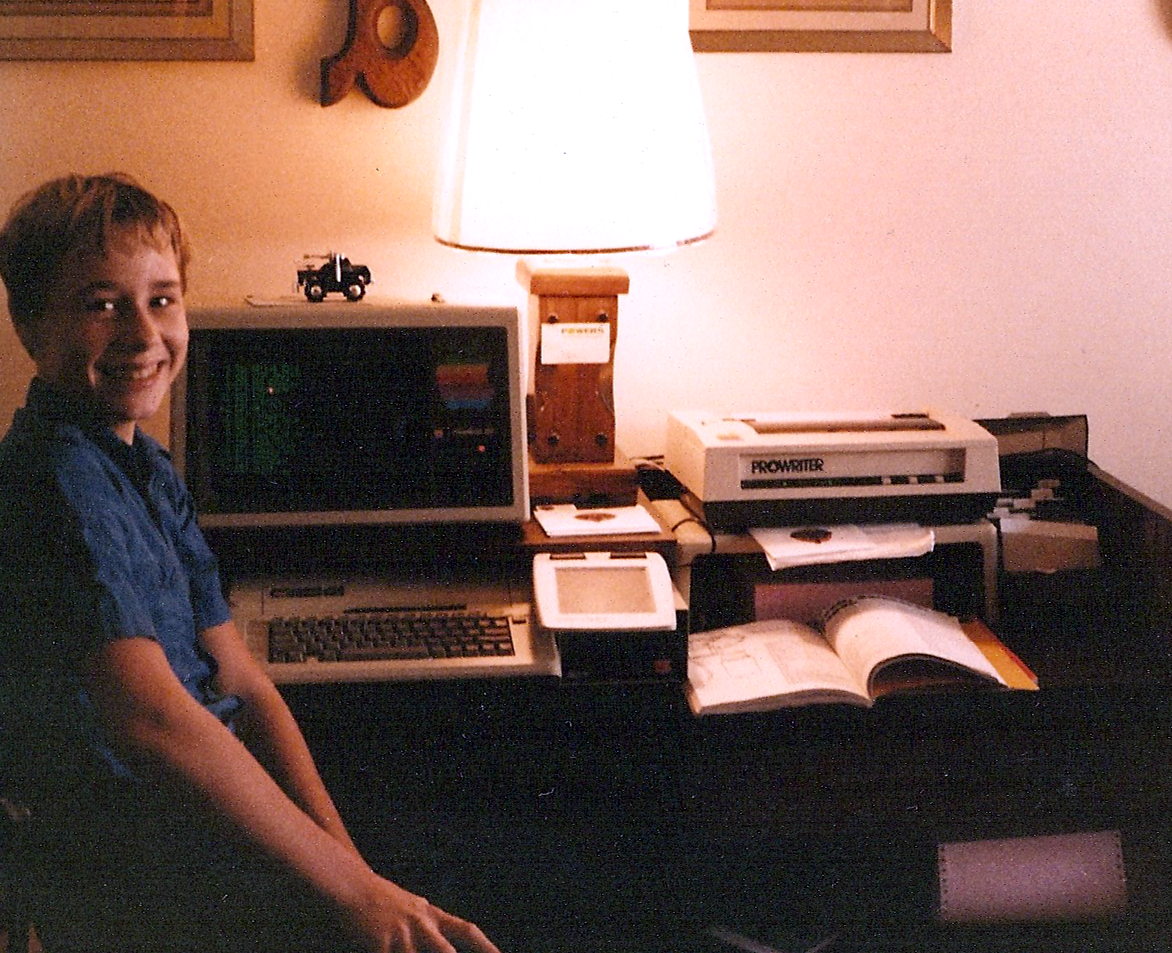
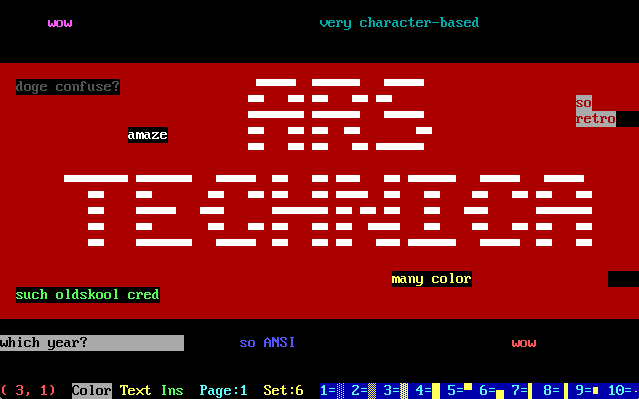
Commentary before posting the article, I was a SysOp of a couple boards, I started a decade earlier than Lee, I started in the late 70's and, I recall when life upgraded to 300 bits per second (bps) from 110 bps and boy that was fast, not a dream of the speeds we suffer with today, I am right now connected at 16,150,000 bps and yesterday was announced speeds achieved 2,110,999,101,440,000,000 bps in the United Kingdom. To give you an idea, 8 bits in a character, so 110 bps would mean text would fill the screen at a rate of about 14 characters per second. My first was running on an Apple //e with a green screen monitor, the second was on PC and appeared in color like the screens below. Above is a photo with my Apple.
Modems, wArEz, and ANSI art: Remembering BBS life at 2400bps
Here's how we geeked out in the era before the World Wide Web came to be.
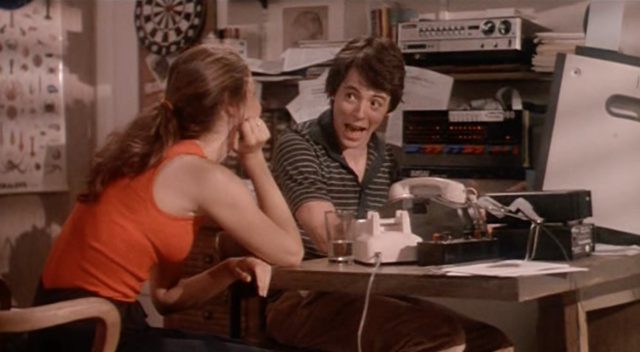
Nerd hero Matthew Broderick uses his modem to actually attract a girl. This did not often happen in real life.
MGM/UA
You've almost certainly never seen the place where I grew up, and you never will because it's long gone, buried by progress and made unreachable by technological erosion and the fine grind of time. What I did and learned there shaped me, but that knowledge is archaic and useless—who today needs to know the Hayes AT command set, the true baud rates of most common connection speeds, or the inner secrets of TheDraw? I am a wizard whose time has passed—a brilliant steam engine mechanic standing agape in the engine room of the starship Enterprise.
I am a child of the BBS era. BBSs—that's "Bulletin Board Systems"—were sort of the precursors to the modern Internet, though that's not quite accurate, since the Internet evolved separately and in parallel. It would be more accurate to say that many people in their 30s and older today were introduced to the world of the Internet either through or because of the interlinked telephone universe of BBSs. That one experience begat the other.
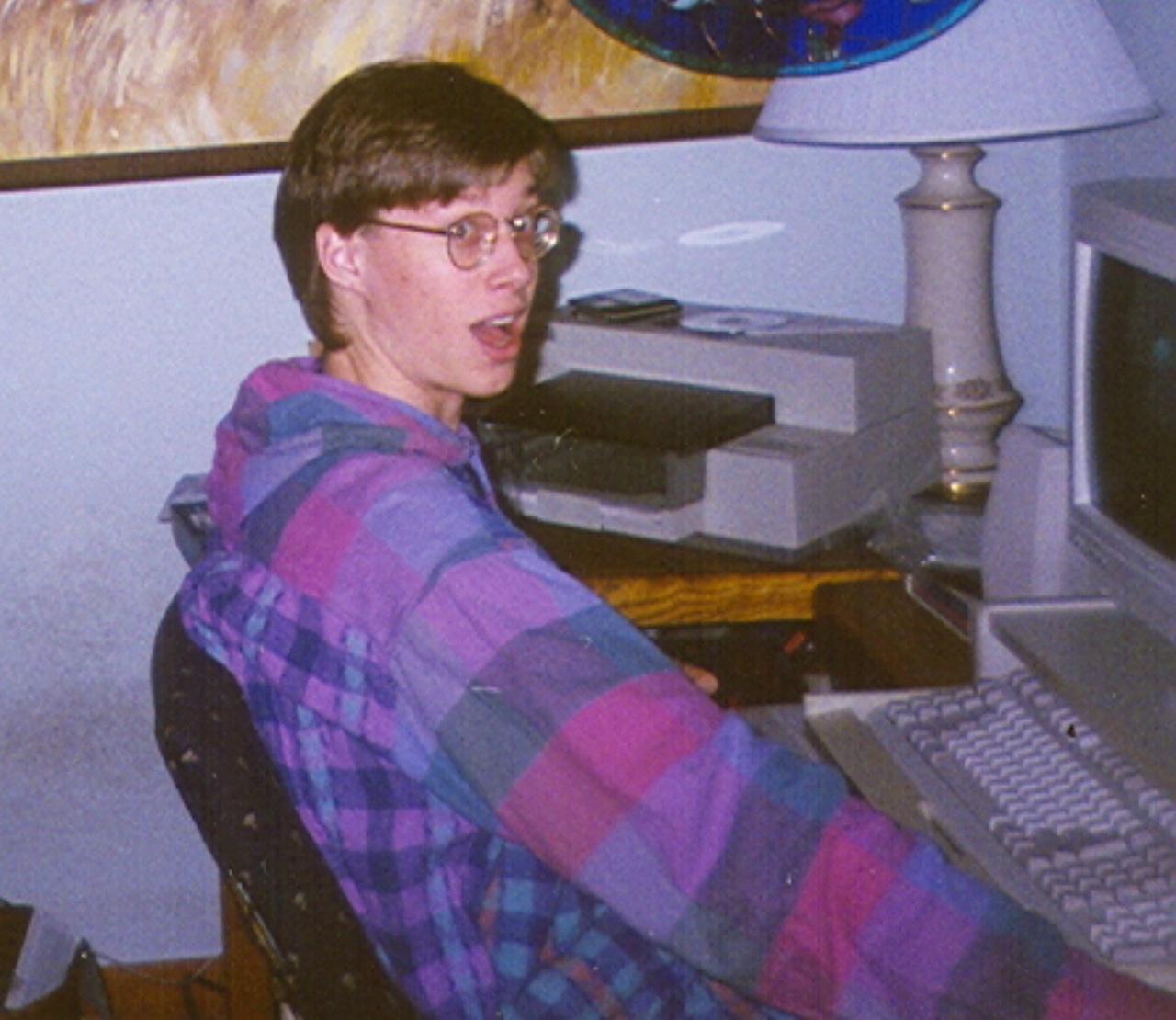
The author near the twilight of his BBS days. Notice the lack of girl, in contrast to Matthew Broderick above.
BBSs existed in a world that had yet to be soiled by smartphones and Facebook and Instagram; there was no Google, and indeed no World Wide Web at all. Up until 1992, the Internet was a thing primarily of text, and BBSs in many ways mimicked that. To get "online" was to sit down at your computer, open up an application called a "terminal program" (or just "term program" for short), pull up your carefully hoarded list of BBS phone numbers, and start dialing. Inevitably, most would be busy and you'd have to wait, but eventually you'd be treated to the sweet sound of ringing through your modem's speaker, followed by the electronic beeping and scratching of a modem handshake.
Oh, there were multi-line BBSs which could host more than one user at a time, but I didn't spend much time at those—the truly popular ones almost invariably required membership fees to support the cost of so many phone lines. No, most BBSs consisted of a single computer at someone's house, connected to a single phone line, which users dialed into one at a time. That remote computer was typically dedicated to the BBS because in the 1980s and early 1990s, multitasking operating systems like we have today were less common and much more temperamental. So, one at a time, users would dial into the BBS, check their private messages, perhaps leave a message on the BBS' "wall" for later callers, read and leave public messages in the message boards (called "subboards" or just "subs"), download and upload files, and then log off. If a modern Web-based forum is a crowded dinner party full of guests all yammering at the same time, a BBS was an entire house that you had all to yourself—one where you could enter, spend some time relaxing and reading books in solitude, write some letters, and maybe rearrange the furniture a bit.
The one who was
I was 12 years old in the fall of 1990, full of bespectacled junior high awkwardness and hunting, as all preteens are, for identity. At the time, my father worked for a big savings and loan firm, and in order to be able to occasionally do some work from our home PC, he was loaned a Hayes Smartmodem—a heavy external box that connected to our Acer 286/12 desktop via a thick RS-232 cable. I truly don't know if my dad ever used the device for work, but once the thing was plugged in, my world changed.
Enlarge/ Chunky, heavy, and awesome: the Hayes Smartmodem 2400.
It came with some janky business-oriented communications application—likely Bitcom, but it was a long, long time ago and I don't remember the exact name—which was preprogrammed with a big list of (useless, to me) access numbers for business services. Seeing how interested I was in the device, my dad got the IT folks at his job to write down a few local BBS numbers for me to dial into.
The first BBSs I called, courtesy of that list, were hosted on Commodore computers running theSpiceWare BBS hosting software. If you happened to be using a Commodore computer with asemigraphical term program, it was a colorful and sound-filled experience (there's a video on the linked blog post of what a SpiceWare BBS looked like). For me on my IBM-compatible PC without even ANSI graphics, all I remember is a lot of red text.
I didn't care. It was absolutely incredible. It was like the computer in front of me had gained another dimension—it had become TARDIS-like, suddenly containing far more than its physical dimensions seemed to be able to allow. My computer could talk to other computers, and it felt like the boundaries of the world had just been blown out, like a cardboard box stuffed with dynamite. After I registered for an account on that first BBS, the remote system's menu showed me cryptic but exciting things I could do. Post messages? Download files? Play door games? Chat with the sysop? What's a sysop?
Learning the lingo
When it came down to it, there were three major activities one could do on a BBS: read and post messages, upload and download files, and play games. I quickly came to realize that me being on an IBM-compatible system meant that the files on these Commodore-hosted BBSs were useless to me, but I immediately fell in love with the message subboards. People were talking to each other! Inside the computer! And I could talk to them! And they would sometimes talk back!
These weren't multi-line BBSs, though, so the communication was very much serial. You'd call in, check your private messages to see if anyone had left you any, maybe take a peek at the public "wall" to see if anyone had scrawled anything funny, then flip over to the subboard of your choice and check for new posts there. For me, this was all done in text, though for Commodore users there were colors, semigraphics, and even sounds.
A "sysop," I quickly found out, was short for "system operator"—the person who ran the BBS. The sysop had administrative power and could do anything. On some BBSs they were jovial benefactors; on others, they were message-editing, power-abusing tyrants.
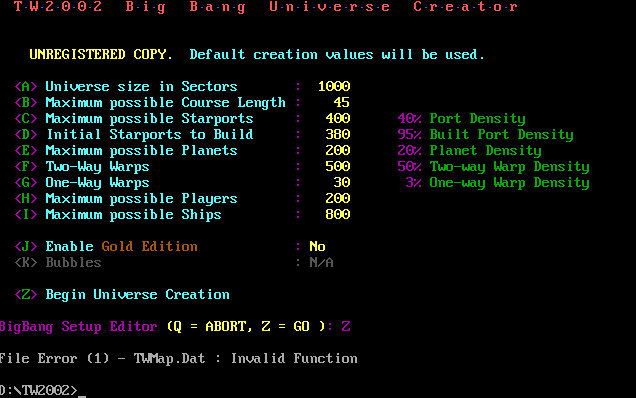
"Door games" were games that could be played through the BBS's text interface. They ranged from simple things (like maybe a Blackjack game) to deep, rich, complex simulations like Tradewars 2002. They were called "door" games because they were usually self-contained external applications, and the BBS application accessed them through an interface colloquially called a "door."
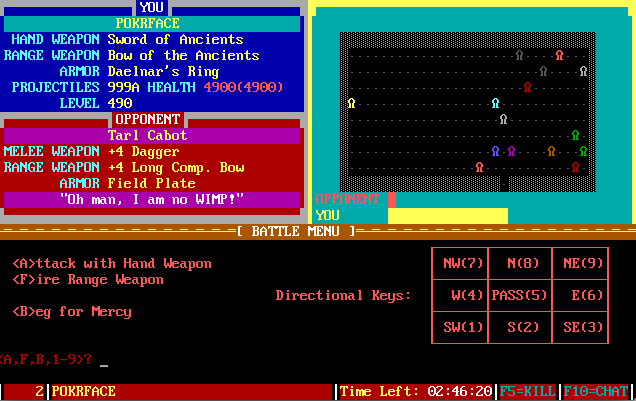
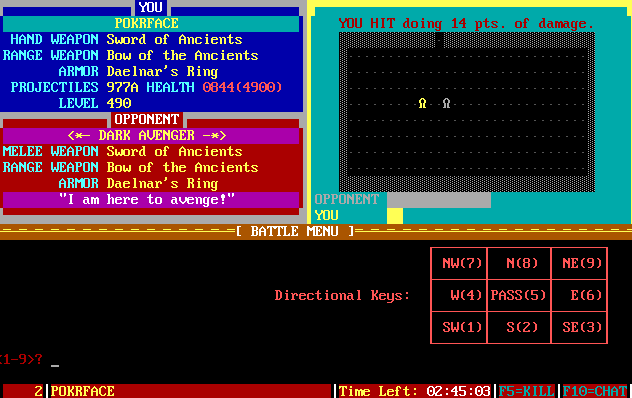
The Pit, a BBS door game. In this shot, I'm attacking these guys. Or maybe they're attacking me.
For most BBSs, the message subboards were the main reason people called in, and many BBSs tried to keep users active in those boards by enforcing a "PCR"—that is, a "post/call ratio." Users who wanted to download files had to post a certain number of messages in the subboards to keep their PCR up in order to be given access to the files areas. This often backfired, with some people posting useless "Post to get my PCR up!" type messages. On the other hand, you didn't want people hogging the board up, so users could only call in for a limited amount of time each day—often an hour. You could also bank your extra, unused time, sort of like rollover minutes. If you were done with a board for the day after only 20 minutes, you could stuff the other 40 into your time bank and use it later.
And the files—oh, the files. Once I started calling IBM-PC boards instead of Commodore-hosted boards, the files sections started to get more and more interesting. BBSs had different kinds of files depending on what the sysop wanted to do with his or her BBS; some boards had lots of programs to download and run, like screensavers or graphical demos, while some focused on amassing and distributing tremendous libraries of text files. It was rare to find a board without an ASCII copy of The Anarchist's Cookbook; the Cult of the Dead Cow or SubGenius texts were also heavily traded.
There were three other things you might see in a BBS's file area as well, and they were all weirdly linked together—ANSI art, MOD files, and warez. But before I could find out about any of those things, I had to escape from Commodore BBSs and start dialing into PC-run boards.
Speed—or lack thereof
But before that, we need to take a moment and put all of this modem stuff in perspective because you can't understand what it was like back then without understanding exactly how slow 2400bps is. We are accustomed these days to rich webpages and files delivered to us over always-on multi-megabit-per-second Internet connections, but that was the stuff of universities and governments back then. To put 2400bps in some perspective, that's 2.4Kbps, meaning that the last generation of 56Kbps modems were about 23x faster than poor old 2400bps. And everyone knows how "slow" 56K was.
At 2400bps and typical encoding, a single character took 10 bits of transmission (a start bit, a stop bit, and eight bits for the character itself, though other encodings were also used), and so the character rate maxed out at 240 characters per second. This was slow enough that you could actually see the screen fill with text, line by line. At 1200bps, fast readers could find themselves waiting on the remote computer; at 300bps (rare but not unheard of in the early 90s), fast typists could at times out-type their connection speed.
For text, 2400bps was perfectly adequate, but downloading binary files—images, large text files, compressed binary files, whole applications spread across floppy-sized disk images—took a long time. Exactly how long? The general rules of thumb to quickly estimate how long your download would take at 2400bps were that 1KB took about five seconds; 100KB took about eight minutes; and 1MB took about an hour and a half.
For someone who's never used a BBS—or for someone who's never had anything other than a broadband connection—it's hard to really explain just how different that is from today. Even downloading a single 256-color GIF usually meant several minutes of waiting, and a large multi-megabyte download was almost always an overnight commitment. There were a few ways to eke out more speed from your download—some download protocols like Puma and Lynx played games with the packets and sent them in batches rather than waiting for acknowledgments, and a few even used compression—but for the most part, you simply put up with it. Or you shelled out hundreds of dollars for a faster modem—not an option for my broke junior high self.
How bad was it then compared to how fast things are now? About this bad:
The comparison is so unbalanced it's almost meaningless, and it's the last line that puts it over the cliff of ludicrousness—a modern broadband connection matches and in some cases exceeds the bandwidth available to an early 1990s hard disk drive (the comparison becomes even more insane at 50 or 100 Mbps).
How could we possibly stand it without rioting? The answer is simple: you can't miss what you've never had before. 2400bps was as fast as most of us had—most of us who weren't rich or actively distributing warez, anyway—so 2400bps was what we used. It was slow, but it was simply the way things were.
Term programs, World War IV, and the golden age
I acquired more BBS numbers from each board's public phone list, and I quickly found out that when calling into PC BBS systems, I needed something far more powerful than the default terminal program. There were many choices, but everyone I talked to recommended something called ProComm Plus, which massively improved on my default program by offering things like an extensible phone book and the ability to display ANSI "graphics"—colored text and extended characters that could be strung together to make rudimentary images.
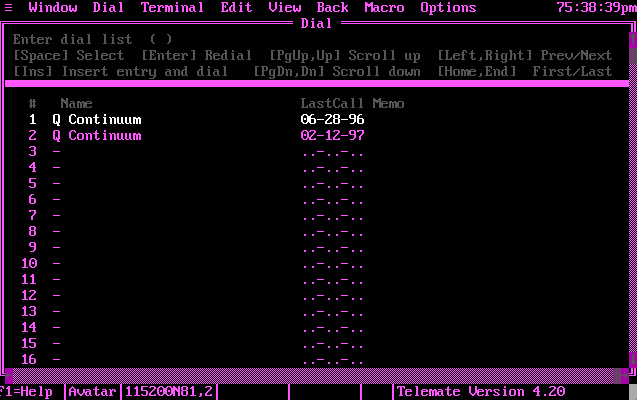
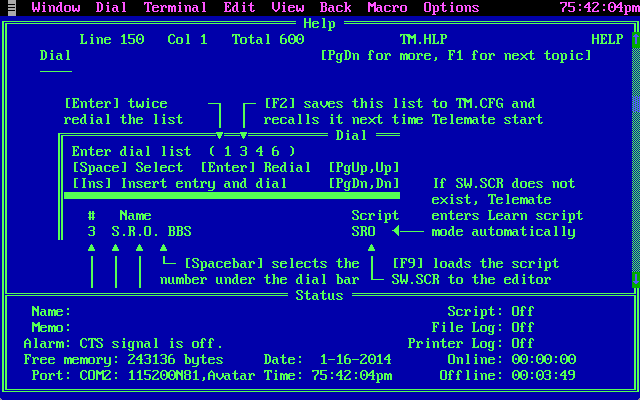
Telemate's dialer screen. I was incredibly excited to see that the copy of Telemate I had sitting in my archive directory was my actual old version, complete with the last two Houston BBSs I used to call (and my actual last two connection times!). Also, Telemate apparently isn't Y2K-compliant, because it thinks it's 75 o'clock.
However, the term program I used more than anything else was the venerable Telemate, by White River Software. Telemate had it all: it was a multi-threaded application and could actually do a lot of neat things simultaneously. It had a configurable "back buffer" so that you could go back and look at things that had scrolled off your screen (remember, this was MS-DOS—cut-and-paste and scrolling were both a big, big deal), a text edit window you could open and close, functional cutting and pasting, and a rich macro language that could be used to do things like automatically enter your username and password on certain BBSs. It also had a powerful, extensible dialing list—great for automatically finding that one BBS without a busy signal on a Sunday afternoon.
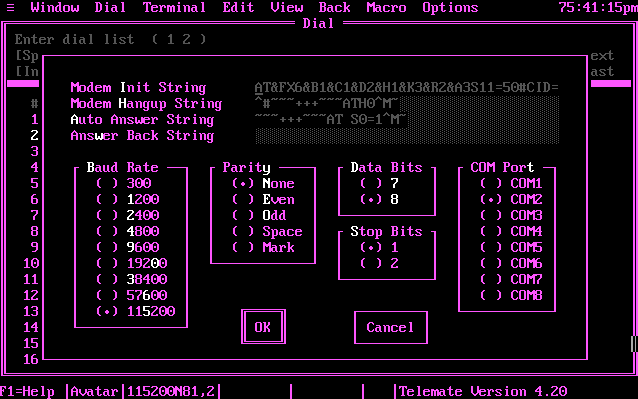
Configuring Telemate's main comm options. Note that awesome extended init string! At the time I was rocking a USR Courier V.Everything, so I had all kinds of extra registers to control.
Just as there were different terminal programs for users, there also was a plethora of BBS host applications, too. Different areas of the country tended to have different BBS applications that dominated; here in the Houston area, most of the boards I ended up frequenting for many years used a program called TAG (properly styled "TAG!"), which shared many similarities with the vastly popular WWIV BBS application (which in turn had spawned other similar-looking BBS applications likeTelegard and Renegade).
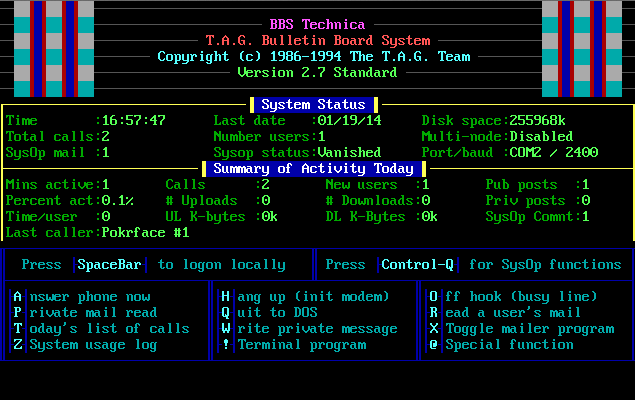
The secret magic screen TAG sysops stared at while waiting for someone to call.
Although TAG was by no means the only BBS application in general use around Houston, the majority of the BBSs I called into in the 1990s used it. When I think of furtively downloading a pirated version of DOOM, in my head I see the TAG download interface. When I think of those very first arguments I ever had about Macs versus PCs or who the superior captain of the Enterprise was, it's in the ANSI colors of the TAG message board composition window.
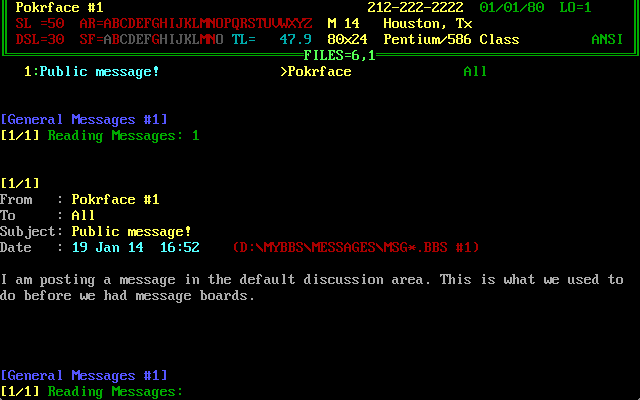
Posting and reading messages on a BBS looked pretty much like this.
That was truly the prime draw of it all—all that talking and arguing with fellow geeks. Through the computer, we were all democratized—we transcended social stigmas and the crushing weight of the high school popularity pecking order. Our voices mattered—to each other anyway. On the whole, no one really cares about a bunch of geeks talking about geek things, but to us, the reality of owning a medium was profoundly empowering. No one was going to make fun of anyone for arguing over whether attack matrices were a superior system to THAC0. Your viewpoint might be mocked, but not the fact that you were having the conversation. Not as long as you were posting in the appropriate sub.
Each BBS was an island (relay mail between BBSs was a thing, but I rarely used it), and each board included its own cliques and pecking order. A sysop on one board might be a "co-sysop" on another (effectively an assistant system administrator with most of the sysop's powers—banning users, reading other users' private messages, and so on). Or he might not be—just because you had your own BBS didn't automatically give you any rights on someone else's board. Particularly trusted users might be made "subops" of particular discussion subboards, granted powers much like a forum moderator of today. To be a subop or a co-sysop was a mark of high status, and it was pretty common for folks to try to beg and wheedle their way into those roles merely to hold it over other users.
Long distance fees kept most BBS users confined to their local area codes; I stayed local for fear of invoking my parents' wrath (and, later, when I started paying for my own phone line, I was even less inclined to call a board outside my area code). You'd see the same nicknames pop up over and over again on different boards—it was common for a user you knew on one board to appear on another, too, since there were at most a hundred or so really popular local BBSs at any given time. In-jokes flourished in our semi-closed ecosystem, and things felt downright cozy.
Of course, there was a whole world outside of the 713 area code. Game manufacturers in particular had BBSs that glittered like jewels, just outside of my reach, promising hints and mysterious fixes—"patches," they called them. Once, after begging and begging, I was given permission by my parents to dial into Sierra's BBS so that I could download a patch to fix a game-breaking bug in Quest for Glory 4. Calling that faraway BBS felt a little bit like making a holy pilgrimage—after playing Sierra's games for so many years, I was going to actually talk to their computers! (The patch ended up fixing the issue but also made it impossible to reload any of my saved games. I never finishedQFG4.)
I learned things in this world, things that teenagers these days have to pick up from the infinite multitude of Web-based discussion boards and social media. Back then we didn't have to worry so much about our parents finding our smartphones and our snapchats and our Facebook posts, though, because barriers to entry were higher. Our world was cloaked not just in passwords, but in incantations and ASCII arcana. Even dialing into a BBS required a bit of understanding of how the term program you were using worked. Without some idea of what you wanted to accomplish, it would have been difficult to puzzle out how to do it.
Can't figure out your terminal program? No worries! Here's your help screen! ALL BETTER NOW, RIGHT?
Xmodem! Ymodem! Zmodem!
Even downloading files—something that today is done almost without thought by clicking links on a webpage—took some thought and know-how. You didn't just "download" something from a BBS, you had to actually tell your terminal program that the data it was about to receive was a file and not text to display. This meant configuring and using a download protocol. The three most common protocolswere Xmodem, Ymodem, and the sophisticated and widely used Zmodem; each of them let you download files, but Zmodem was far and away the easiest to use.
Poor old Xmodem didn't know anything about what you were downloading. You'd pick a file from the remote BBS to download, but then you had to hit the "download" key in your term program, select the Xmodem protocol, supply a file name to save the download as, and wait. The remote computer didn't transmit anything except data—no error correction, no size, no time remaining, nothing. Ymodem introduced a bit of error correction, but it wasn't much better.
Zmodem, on the other hand, was the protocol of kings. It was fast—it streamed rather than requiring an acknowledgment after each packet. It was smart, too—it even let you restart aborted downloads, which was a huge bonus when each megabyte downloaded represented almost 90 minutes of real time, and a large interrupted download could mean a whole day wasted.
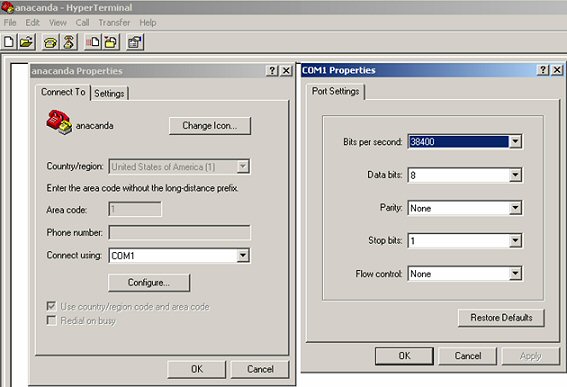
Other more exotic protocols were around too if you wanted to download their binaries to set them up (and if the BBS you were calling supported them). Of particular note was Hilgraeve Software'sHyperProtocol, a streaming protocol which included a bit of compression. You might not ever have used it, but anyone who worked in IT has almost certainly used the terminal emulator Hilgraeve produced a few years later: HyperTerminal.
Remember this thing? It's got a surprisingly complex history.
MOOOOM, DON’T PICK UP THE PHONE!
In a time when my family only had a single landline, time on BBSs had to be carefully negotiated. Every moment I was living in that world was a moment where the phone was off-hook and no one could call our house. Relatives began to complain about always getting a busy signal when they dialed us, and I received more than one talking-to from my parents about always being on the phone. In that respect, I suppose I was like most teenagers.
Modems work by encoding digital information into an analog signal, and most people have heard the static-y "HISSSSSSS" of modem communication. Noise was data, and extraneous noise in a connection between two modems—noise from a bad connection, or noise introduced by someone's mother picking up the phone—caused errors. As modems grew more sophisticated, error correction techniques like MNP and V.42bis began to appear on consumer-priced modems, but when I first began dialing into BBSs, error correction wasn't common on 2400bps modems that normal people could afford.
Minor bouts of line noise looked like random characters injected into the flow of things—annoying, but easily fixable. However, sometimes a relative innocently picking up the phone while you were online would cause your connection to drop, which could be terribly frustrating if you had managed to dial in to a popular BBS that was normally busy.
Our family's computer was located in an add-on room to the house, and that room had no phone jack. For years, I stretched a 50' (about 15 meter) phone cord across half the house in order to get online. This meant that connections were spoiled not only by the occasional picking up of a phone, but also by the occasional tripping over the cord. One of the first things I did when I turned 16 and got a jobwas pay for the installation of my own phone line and a jack in the computer room. It cost me about $50 a month for a number that could call most of Houston (a 332 exchange number rather than the cheaper 554 exchange), and back then I actually spent more on my phone line's monthly bill than I did on gas for my blue 280-Z.
Enlarge/ A high speed (V.90 or V.92) modem handshake, annotated. 2400bps handshakes were much less complex.
Oona Räisänen
Talking to your modem
Regular BBS users became skilled in the Hayes AT command set—the language for configuring and using the majority of modems. Term programs hid a lot of the complexity by automating the process of dialing and using a modem, but to tweak the modem's parameters it was necessary to dive in and start directly changing settings. That meant using AT commands.
When you first started up your term program, it passed a long bunch of commands called the "initialization string," or just "init string" to your modem. This set parameters in the modem's nonvolatile RAM so that the modem would function in the way you expected or wanted. Though my init strings got more complex as I got newer and newer modems, I'll forever remember the string I used with my beloved old Hayes 2400 Smartmodem:
ATE1S7=255S11=35V1X4S0=0
All commands started with "AT," for "attention," to tell the modem it should expect commands. E1 set local echo on (so that I could see what I was typing in the term program's main view). Then the command set several "S registers"—NVRAM locations that held specific settings. "S7=255" set the number of seconds after going off-hook that the modem would wait for a connection to 255. "S11=55" set the DTMF tone length to 35 milliseconds—so when the modem dialed, it would use 35 ms for the length of each dialed digit (shorter DTMF tones meant faster dialing—through experimentation, I found 35 to be the shortest that would work with my local POTS exchange). "V1" told the modem to give me result codes in plain English rather than as numbers (so it would print "BUSY" in the terminal window if it detected a busy signal rather than just printing a number), and "X4" told the modem that it should use as many result codes as it knew how to use—in other words, it should be as smart as possible and respond to dial tones and busy signals rather than blithely dialing away. Finally, "S0=0" set the auto-answer register to 0; setting "S0=1" would cause the modem to automatically pick up the line after the first ring if it heard an incoming call. That would be great if I were running a BBS, but not so great on a line used primarily for voice.
You could also send commands directly to the modem. The most useful was "ATA," which you could type at any point to cause the modem to pick up the line and start trying to connect—great if a friend was going to call to upload a file directly to you. Also useful was quickly typing "+++ATH0"—the "+++" would pull the modem out of data mode and into command mode when you were connected, and "ATH0" would cause the modem to instantly hang up.
Online gaming
We played games in that lost world, too, and some of them were amazing. I spent more time than I care to admit playing The Pit, an arena fighting game where you move your little ASCII character around in an ASCII arena and fight other ASCII characters for loot and fame. I would bank all my excess time on BBSs throughout the week, then make huge time bank withdrawals on the weekends so that I could tie up phone lines for hours bashing imaginary text-mode monsters.
More of The Pit. I might be in a little bit over my head here.
One of the most long-lived and popular door games was TradeWars 2002. TW2002 dropped players into a large persistent universe and gave them a certain number of turns per day to trade, explore, fight, and get rich. It was sort of like a cross between Elite and Galactic Civilization, though the multiplayer competitive aspect of it was absolutely entrancing.
I tried to set up Tradewars 2002 in DOSBox so I could take some pictures, but I couldn't make it work. However, the game pretty much looked just like this anyway.
That multiplayer, though, was "serial" instead of parallel. Most BBSs were single-line, so the game was much more like a huge multi-sided game of chess rather than a modern MMORPG. And that persistent TW2002 universe was really only persistent on single BBSs—your TW2002 game on one board was a different game from your TW2002 game on another board (because, remember, few BBSs were connected together). These were most often single computers being run by a sysop out of his or her house with a single phone line. (Although TW2002 itself did support multi-line BBSs for simultaneous play and even multi-BBS play via relay for sysops who wanted a universe that spanned boards.)
A pirate’s life for me?
And, of course, there was pirated software—which even back then was called "warez" (pronounced like "wares," not like "Juarez"), though it was the style in the mid-'90s to soMeTiMeS wRiTe iT liKe "wArEz." I can't believe I used to write like that, but we all did for a while.
Pirated file areas were sort of like secret bars in the 1920s—everyone knew where they were, but you didn't really talk about them in public. Saying "HEY GUYS ANYONE GOT ANY WAREZ" on a BBS' message boards might get you immediately kicked and blacklisted; quietly approaching the sysop in chat and mentioning that you heard from another board user that there were "private" files for download, on the other hand, might get you access—provided someone could vouch for you.
Through BBSs, I came to know the world of pirate release groups—the Scene. As I downloaded applications I wanted to use but could never pay for (like the incredible, inimitable XTree Gold) I quickly became familiar with the legendary names: groups like iNC, THG, Fairlight, and the still active seemingly immortal RAZOR 1911. These were the people actively cracking software and distributing it, and they were mythical creatures in my teenage eyes.
Pirated software in the BBS days was very different from its modern times' equivalent. Grandparents tell stories of how back when they were young, they didn't even have to lock the doors of their houses because crime was so low, and that same golden-age recollection applies here. You simply didn't have to worry about viruses from a scene release. The cracking groups all competed viciously for reputation and popularity, and no one would sign their name to a release tainted by a virus. They put out clean software, and like hippies at Woodstock, we rarely worried about viruses or protection.
Intros, cracktros, and ANSI art galore
Oddly, the pirated software scene and the digital art and music scene were closely intertwined. BBSs were primarily a textual medium, but "text" can mean many things beyond the alphabet and basic punctuation. Skilled artists existed who could take extended ANSI characters and colors and create not just recognizable artwork, but legitimately amazing images.
Enlarge/ "Ansi Blondie," by Reanimator of iCE. This is all made out of colored ASCII characters.
Many of these artists were also either tied to or directly members of big cracking groups, and their services were very much in demand. A piece of pirated software would always have a file in it that contained information about the release, including who released it; those files would typically have embedded ASCII or ANSI art in them. Further, the BBSs where cracking groups directly communicated and hung out needed to be decorated, and these often featured incredibly elaborate logon screens and backgrounds.
ANSI art remained intertwined with the cracking scene, but it also evolved its own elaborate scene, with its own conventions and stars. Art groups like ACiD and iCE flourished in the 1990s, releasing incredible art often made out of nothing more than colored characters.
The mass of skilled coders and artists did far more than simply crack software and make images taunting rival groups; it became popular for pirate groups to include musical and graphical "intros" alongside their releases. An "intro" (or "cracktro," since the intro would often accompany a cracked piece of software) was a small self-contained musical calling card—typically, it would be a set of stills or animated images with a 4-channel digital audio song (like a .MOD) playing in the background. There would almost always be a list of "greets" in the intro, where the coders shouted out praise to their friends and talked smack about rival groups.
I fired up TheDraw to make some bitchin' ANSI art myself, but discovered that I cannot art any better today than I could back then. So, this is the best I can do—going for kind of an ironic statement, I think.
Intros moved beyond simple calling cards and evolved into massive applications designed to push computers of the day to their limits, and many of the players that started out in the demoscene are still active today in one form or another. For example, Future Crew, creators of arguably the two most famous demos of all time (Unreal and the mind-blowing Second Reality) are still coding—you might recognize their work at Remedy Entertainment and FutureMark.
Speeding up—9600, 14400, and beyond
In early 1994, after years and years of 2400bps, my dad bought me a high-speed modem. I graduated to 9600bps. At that time, the fastest thing you could buy was a USRobotics HST modem, which operated at 16800bps using USR's proprietary HST communications scheme. After that, 14400bps was widely popular and became what the elite used.
I was thrilled to have my 9600bps modem, though, since it represented a five-fold increase in speed over poor old 2400bps. I still remember the absolute joy of watching my download rate jump to 1KB per second—it was magical, watching those numbers tick away so quickly. I could download 100KB in a little over a minute and a half! A megabyte in a bit over 15 minutes! I could download anything.
Of course, all that speed led to me downloading a lot more stuff—mainly pirated software and music. By that point, our 286/12 had long been replaced—we got a 386/25 with a Soundblaster Pro—and I fell headlong into the world of .mod files and more complex digital audio files. I filled expensive hard drives with applications and music, trying to see and discover everything.
The end of all things
By the time I bought myself a 28800bps modem in 1996, my BBS use had faded to nothing thanks to a new and much more addictive thing: the Internet. Thanks to Netcom Netcruiser, I left behind my door games and file areas and quaint local subboards for the mid-'90s Internet, which was itself still a relatively young and wild thing (especially the nascent World Wide Web, which was at the time only a few years old).
Sadly, this thing right here killed BBSs for me.
But even as my online world gained width and breadth, it lost a magical sense of depth. There are somany things to do on the modern Internet; even the Internet of 1995 and 1996 was a vast ocean of destinations and information. Gone, though, was the intimacy of the BBS—it was all fine and good to speak of visiting someone's homepage on the Web as a personal experience, but the ephemeral loading of a webpage is nothing in comparison to dialing into a BBS that a person has specially crafted for visitors. It's the difference between reading a billboard on the side of someone's home and actually entering that home to sit down for tea.
It seems crazy that the text-based world of BBSs could still resonate so much with me, but what I learned there underpins most of how I use the Internet today. I learned how to talk with other people in a forum, how to quote replies, and how to construct an argument. I learned how private messages work. I learned about compressed files and archives—would it surprise younger Internet users to learn that we used PKZip and ARJ back then, just as we do now? I learned how to flame someone and how to respond to being flamed. I learned about analog communication and modems and hard drives and how computers worked—I had to learn, because that was the only way to get "online" back then.
And I miss it. There was an innocence then that's absent now from the online world. You'd never see an ad on a BBS; you'd never get spam in your inbox or have to worry about your parents or your boss finding out about a picture you'd posted (because, really, "posting" that picture involved a whole hell of a lot of steps). You worried that "the government" might find out you downloaded a text file telling you how to build a blue or red box, but you didn't really worry about it.
What we have now is quantifiably better in just about every way... but you love the things you grew up with. Some BBSs are still around, though most are accessible via telnet, and that's just not the same. My generation is in a perfect spot to have experienced it in the mid-1990s—those older than I were in college at the time and were cutting their teeth on the actual for-real Internet, using USENET and FTPing files around with abandon. Those even a few years younger than I missed all of it and likely got their first introduction to a modem through nascent services like America Online or Prodigy.
They'll never know what it was like to prank-call friends' BBSs late at night, whistling into the receiver to trick the remote modem into trying to train against your whistle and lock up. They can't recall the thrill of discovering the full registered version of Wolfenstein 3D on a private board for the very first time or the joy in slaving over TheDraw for hours to produce the perfect ANSI signature to append to your messages.
Childhood ends for everyone, but I'm glad I spent mine online.